Cereal may be a dry food, but keeping it fresh from production to the customer's kitchen requires more than putting it inside a cardboard carton. Grain-based products can be affected by moisture, oxygen, light, pests, crushing, and poor storage conditions. The right packaging system helps manage these risks while also providing the structure and branding needed for retail shelves.
Food cereal boxes typically work as part of a packaging system rather than as the only protective barrier. The outer carton provides structure, printing, product information, and shelf presentation, while an inner bag or liner can provide important containment and barrier properties.
For cereal brands, understanding how these components work together is essential when developing packaging that supports freshness, safety, shelf life, and customer satisfaction.
Why Cereal Packaging Needs Protection
Cereal products are generally low-moisture foods, but they can still lose their desirable qualities when exposed to unsuitable conditions.
A package needs to help protect the product throughout several stages, including:
- Manufacturing
- Filling
- Warehousing
- Transportation
- Retail storage
- Shelf display
- Consumer storage
Each stage can expose the product and packaging to different conditions.
Freshness Is More Than Taste
For many cereals, freshness is closely connected to texture.
Customers expect products such as flakes, toasted grains, granola, and crunchy cereal mixes to maintain their intended texture.
If the cereal absorbs excessive moisture, its crispness can decline.
This is why moisture management is an important part of cereal packaging design.
The Outer Cereal Box Provides Structure
The familiar cereal carton has an important job even when an inner bag provides the primary food-contact barrier.
The outer box can:
- Protect the inner package
- Support stacking
- Provide a printable surface
- Display product information
- Improve shelf presentation
- Help maintain the shape of the retail package
A properly designed carton can also make the product easier to handle throughout distribution.
The Inner Bag Is an Important Barrier
In many cereal packaging systems, the cereal is placed inside an inner bag or liner before being enclosed in the carton.
This inner package can provide properties that the outer carton alone may not offer.
Moisture Barrier
A suitable inner package can help limit moisture transfer.
This is particularly important for cereals where crisp texture is a key part of the eating experience.
Product Containment
The inner bag keeps the cereal contained and can help prevent direct contact with the outer carton.
Additional Protection
Depending on the material, the inner package can also provide protection against oxygen, odors, and other environmental factors.
The required barrier properties depend on the specific cereal formulation and expected shelf life.
Moisture Can Affect Cereal Texture
One of the most important concerns for dry cereal is moisture.
Cereal that absorbs moisture can become less crisp and may no longer provide the texture consumers expect.
Packaging Design Helps Manage Exposure
The complete package should be designed to provide an appropriate moisture barrier for the product.
This involves more than simply choosing a cardboard box.
The inner bag, sealing method, carton construction, and storage conditions all matter.
Sealing Is Important
Even a suitable barrier material can perform poorly if the package is not sealed correctly.
Manufacturing processes should therefore be tested to ensure the inner package closes consistently.
Oxygen Can Also Matter
Some cereal products contain ingredients that can be affected by oxygen exposure.
Products containing nuts, seeds, oils, or other ingredients may require additional consideration.
Oxygen exposure can contribute to quality changes over time, including oxidation of susceptible ingredients.
The appropriate barrier level depends on the product formulation and expected shelf life.
Light Protection Depends on the Product
Light sensitivity varies between food products.
A carton can provide an additional layer between the contents and retail lighting.
For certain cereal products, the outer box can help reduce direct light exposure to the inner package.
Brands should evaluate whether light protection is relevant to their specific formulation and packaging system.
Packaging Helps Prevent Contamination
Food packaging should help keep the product protected from external contaminants during normal handling and storage.
The complete packaging system should be designed for the intended food application.
Food-Contact Materials
If a component directly contacts the cereal, its material specification should be appropriate for that use.
This may involve evaluating the inner bag, coatings, adhesives, inks, and other components.
Brands should obtain appropriate documentation from their packaging suppliers and comply with applicable food packaging regulations in their target markets.
Cereal Boxes Also Protect Against Physical Damage
Cereal can be surprisingly vulnerable to crushing.
Flakes and other delicate pieces can break when packages are dropped, compressed, or handled roughly.
The outer carton can provide structural support around the inner package.
Stronger Packaging for Distribution
Cereal boxes may be packed into larger shipping cases and stacked during transportation.
The box material and construction should be selected according to the expected distribution environment.
Avoid Excessive Compression
Packaging should be strong enough to maintain its shape without putting unnecessary pressure on the cereal.
Testing is important because actual distribution conditions can vary significantly.
Custom Dimensions Improve Product Fit
Food cereal boxes should be sized around the actual product and inner package.
A box that is too large can leave excessive empty space.
A box that is too small can make filling difficult or place pressure on the contents.
Better Fit
Custom dimensions allow brands to design a carton around the specific cereal quantity and inner package.
More Efficient Use of Material
Right-sizing can help avoid unnecessary packaging material.
Improved Shelf Appearance
A properly proportioned cereal carton can look more balanced on the retail shelf.
Cereal Packaging and Shelf Life
Shelf life is influenced by the food itself, processing, packaging, and storage environment.
Packaging should therefore be developed based on the product's actual shelf-life requirements.
Consider the Entire Packaging System
A cereal box should not be evaluated independently from its inner bag.
The box and inner package have different functions and need to work together.
Conduct Appropriate Testing
Brands can work with packaging and food specialists to evaluate factors such as moisture transmission, oxygen exposure, sealing performance, and product stability.
Testing provides more reliable information than assuming that a particular package will automatically preserve freshness.
Choose Materials According to the Product
Different cereal products can have different packaging needs.
Flaked Cereals
Lightweight flakes may require particular attention to crushing and moisture control.
Granola
Granola may contain oils, nuts, seeds, dried fruits, or other ingredients that influence packaging requirements.
Whole-Grain Cereals
Whole-grain products may have different shelf-life considerations depending on their formulation and ingredients.
Children's Cereals
Children's cereal may have the same basic freshness requirements while placing greater emphasis on colorful graphics and shelf appeal.
The packaging should therefore be developed around the actual product rather than applying one specification to every cereal.
Food Cereal Boxes Need Clear Labeling
Packaging is also an important source of information.
Depending on the market and product, cereal boxes may need to display information such as:
- Product name
- Ingredients
- Nutrition information
- Allergen information
- Net quantity
- Storage instructions
- Manufacturer information
- Barcode
- Date-related information where required
Regulatory requirements vary by country and product category.
Brands should confirm the applicable requirements before finalizing artwork.
Barcode Placement Matters
A barcode should be positioned on a suitable area of the package where it can be scanned reliably.
Avoid placing it across folds, seams, or areas where printing quality may interfere with readability.
Retailers or distributors may also have their own packaging requirements.
These should be confirmed before production.
Shelf Appeal Still Matters
Food safety and freshness are essential, but cereal packaging also has to compete for attention.
The cereal aisle can contain dozens of brands and varieties.
A package should make its identity clear at a glance.
Strong Brand Recognition
A recognizable logo can help customers identify the brand.
Clear Product Name
The product name should be easy to find.
Appropriate Product Imagery
Images and illustrations can help communicate the product and its ingredients, provided they accurately represent what customers can expect.
Sustainable Food Cereal Boxes
Many brands are exploring more responsible packaging options.
Paperboard and kraft-based cartons can form part of a sustainable packaging strategy, but the entire system needs to be considered.
Evaluate:
- Fiber sourcing
- Recycled content
- Inner bag material
- Coatings
- Inks
- Adhesives
- Package size
- Transportation
- End-of-life options
A paper-based outer box does not automatically make the complete package environmentally friendly.
Reduce Excess Material Without Reducing Protection
Right-sizing can help reduce unnecessary material.
However, reducing packaging too aggressively can create product damage or shorten usable shelf life.
Good packaging optimization should balance material efficiency with product protection.
Custom Printed Cereal Boxes Strengthen Branding
Custom printing gives cereal brands control over the appearance of their packaging.
A consistent visual identity can be applied across multiple products.
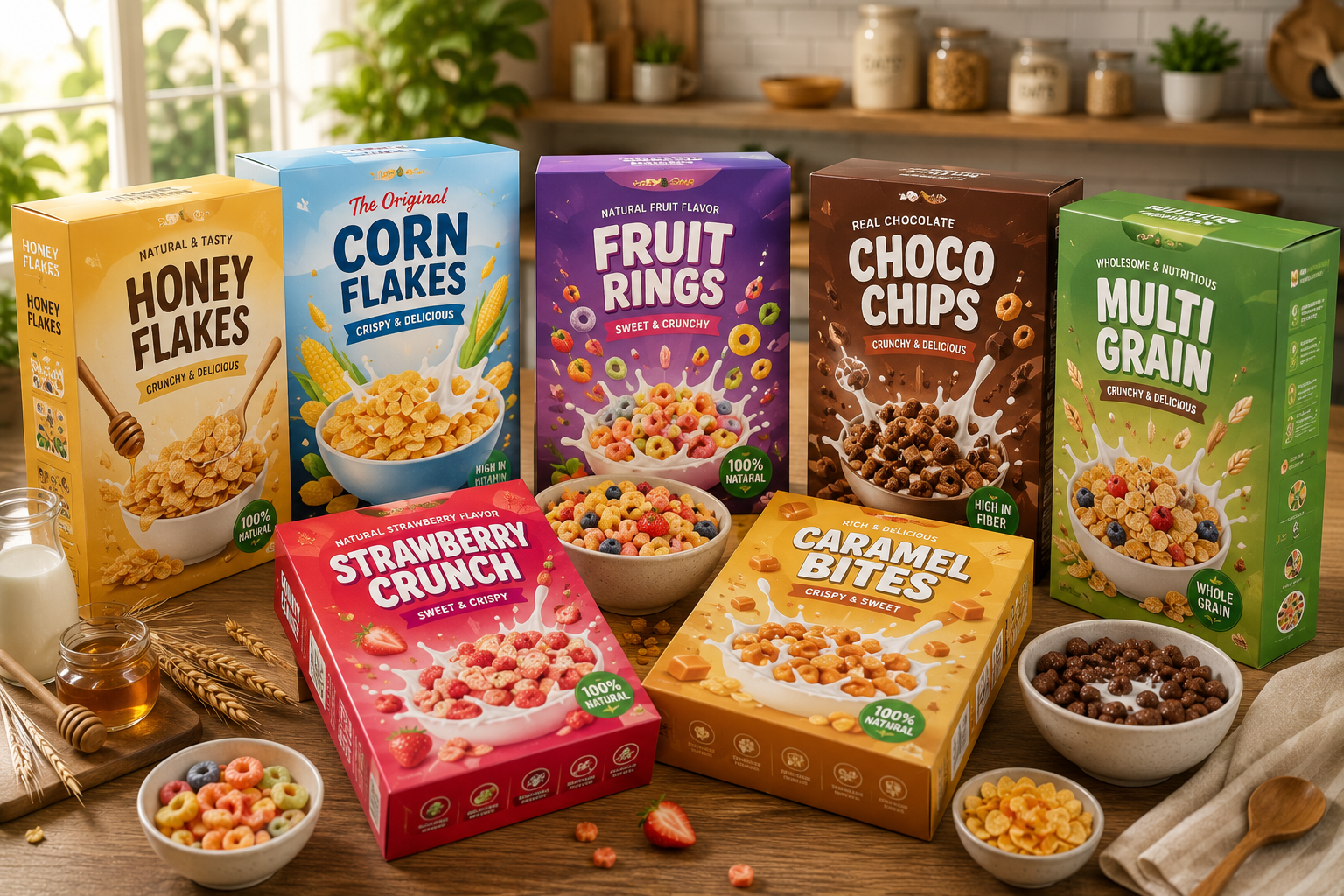
For example, a brand may use the same logo and typography across several cereal varieties while changing the dominant color and product imagery.
This creates a recognizable product family.
Wholesale Cereal Packaging Can Improve Consistency
Brands with regular cereal production may purchase packaging in larger quantities.
Wholesale ordering can potentially reduce unit costs and help maintain a consistent packaging supply.
However, buyers should calculate their expected usage before placing a large order.
Ordering too many boxes can create storage problems or leave a business with outdated packaging if the design changes.
Test Before Placing a Large Order
Testing is one of the most important steps in cereal packaging development.
A sample should be evaluated with the actual product and inner package.
Check:
- Product fit
- Inner bag placement
- Sealing
- Box strength
- Closure
- Shelf appearance
- Stacking
- Transportation
- Printing quality
If possible, conduct appropriate product and package testing under realistic storage conditions.
This can help identify weaknesses before full production.
What Brands Should Ask Their Packaging Supplier
Before ordering food cereal boxes, ask the supplier about the complete packaging specification.
Useful questions include:
- What material is being used?
- What is the board thickness or specification?
- Is the material appropriate for the intended food application?
- What printing options are available?
- Can the dimensions be customized?
- Can samples be provided?
- What is the minimum order quantity?
- What is the production lead time?
- What quality-control procedures are used?
- What documentation is available for food-contact components?
Clear communication can help avoid costly misunderstandings.
Choose Packaging Around Freshness and Safety
The best food cereal boxes are not designed around appearance alone.
They are developed around the complete product journey.
The inner package should provide the required containment and barrier performance, while the outer carton should provide structural support, information, branding, and shelf presentation.
Custom dimensions can improve product fit, while appropriate materials and construction can help the package perform during storage and distribution.
Boxo Packaging provides custom cereal packaging solutions for brands looking to develop boxes around their product dimensions, branding, retail requirements, and packaging goals.
When cereal packaging is designed with freshness, safety, structure, and shelf presentation in mind, the result is more than an attractive carton. It becomes a coordinated packaging system that helps protect the product from production through the customer's pantry while giving the brand a professional presence on the retail shelf.